Key takeaways
- Grain size affects copper formability by changing dislocation motion, strain distribution, strength, and ductility.
- Finer grains generally increase strength and can reduce uniform elongation.
- Coarser grains may allow more plastic deformation but can worsen surface finish.
- The effect is conditional and depends on alloy, purity, texture, temperature, strain rate, and process.
- Bending, rolling, and drawing respond differently to grain size.
- Grain size is one variable among many; defects and tooling can dominate.
- Evaluate microstructure and forming trials before setting a production target.
What Is the Influence of Grain Size on Copper Formability?
Grain size influences copper formability by changing how dislocations move, how strain is distributed, and how readily the metal accommodates bending, rolling, or drawing without cracking. In general, finer grains create more grain boundaries, which tend to raise strength and can reduce uniform elongation, while coarser grains can allow more plastic deformation before fracture but may increase surface roughening. The net effect is conditional: it depends on copper grade, purity, texture, temperature, strain rate, prior cold work, and the specific forming operation. When comparing oxygen-free copper and electrolytic copper, the same conditional factors apply.
Formability is not a single property. It describes the ability of copper to undergo plastic deformation without failure under a given stress state and tooling condition. A microstructure that performs well in one operation may perform poorly in another, so grain size should be evaluated together with the intended process rather than as an isolated number.
This article explains the general relationship between grain size and copper formability, the mechanisms behind it, the trade-offs that appear in common forming processes, and the factors that can change the outcome. It also outlines practical evaluation steps and notes where information is insufficient for a universal recommendation.
Defining Grain Size and Formability in Copper
Grain size refers to the average dimension of the crystalline regions, or grains, that make up polycrystalline copper. A copper component is not one single crystal; it contains many grains with different orientations, separated by grain boundaries. The average size, size distribution, shape, and orientation of those grains form the microstructure.
Formability refers to the capacity of copper to be deformed plastically without cracking, tearing, or unacceptable surface damage. It includes bendability, drawability, rollability, and the ability to withstand edge deformation. Formability depends on the stress state, strain path, temperature, strain rate, tooling geometry, lubrication, and the condition of the incoming material.
The relationship between grain size and formability is therefore not a fixed rule. Grain size is one microstructural variable among several. A change in grain size can alter strength, strain hardening, and strain distribution, but its practical effect depends on how those changes interact with the forming process.
How Grain Boundaries Affect Dislocation Motion
Plastic deformation in copper occurs mainly through the movement of dislocations along slip planes. Grain boundaries act as obstacles to that movement. When dislocations encounter a boundary, they can pile up, change direction, or require additional stress to continue. This interaction is one reason grain size affects both strength and deformation behavior.
With finer grains, there are more grain boundaries per unit volume. The increased boundary area generally impedes dislocation motion and tends to raise strength. It can also distribute strain more evenly across the microstructure. However, the same boundaries can reduce the distance over which dislocations move freely, which may limit uniform elongation and affect how the material accommodates large strains.
With coarser grains, there are fewer boundaries. Dislocations can travel longer distances, which can make plastic deformation easier in some conditions and may allow greater ductility before fracture. The trade-off is that strain may localize more readily, and coarse grains can produce a rougher surface during forming. Temperature and strain rate further modify these effects because they influence how dislocations move and how boundaries interact with them.
The Strength-Ductility Trade-Off in Copper Forming
A central issue in copper forming is the balance between strength and ductility. Finer grains often increase strength, which can be useful for final part performance, but higher strength may reduce the strain that copper can accommodate before necking or cracking. Coarser grains often lower strength and can allow more plastic deformation, but they may reduce surface quality and dimensional control.
This trade-off is not absolute. The exact balance depends on alloy content, impurity levels, crystallographic texture, second-phase particles, prior deformation, and annealing history. A copper grade with a fine grain size may still form well if the operation involves low strain or compressive stress states. A coarse-grained copper may form poorly if the surface finish requirements are strict or if the strain path is complex.
For practical purposes, grain size should be considered alongside the required mechanical properties and the severity of the forming operation. The goal is not simply to make grains smaller or larger, but to find a microstructure that supports the intended deformation without unacceptable failure or surface defects.
Grain Size Effects in Bending, Rolling, and Drawing
Different forming processes place different demands on copper. In bending, the outer surface experiences tensile strain while the inner surface experiences compression. Fine grains can help distribute that strain and reduce the risk of localized cracking, while very coarse grains may produce an orange-peel surface or uneven deformation. The bend radius, sheet thickness, and tooling condition also matter.
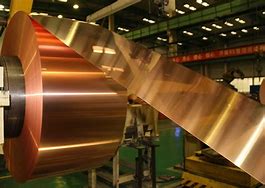
In rolling, grain size influences the reduction that can be achieved, the load required, and the surface quality of the rolled product. Fine grains may increase strength and require higher rolling loads, while coarse grains may reduce strength but can lead to roughening or non-uniform flow. Crystallographic texture, which often develops during rolling, can add directional effects such as earing or anisotropic properties.
In wire drawing and tube drawing, the material is pulled through a die and undergoes large plastic strain. Fine grains tend to increase strength, which may limit the reduction per pass and require intermediate annealing. Coarser grains may permit more reduction per pass but can affect surface finish and dimensional stability. The table below summarizes general ways grain size can influence copper formability; it does not replace process-specific testing.
| Aspect | General influence of grain size in copper |
|---|---|
| Grain boundary area | Finer grains create more boundaries per unit volume; coarser grains create fewer. |
| Yield strength | More boundaries generally impede dislocation motion and tend to raise strength. |
| Uniform elongation | Finer grains often reduce the strain range before necking begins, though other factors matter. |
| Total ductility | Coarser grains can allow more plastic strain before fracture in some conditions, but may promote roughening. |
| Strain hardening | Grain size changes how quickly copper work-hardens during deformation. |
| Bending | Fine grains may improve local strain distribution, while very coarse grains can cause orange-peel surface. |
| Deep drawing | Grain size and crystallographic texture together affect flow, earing, and surface quality. |
| Wire drawing | Finer grains tend to increase strength but can limit reduction per pass without intermediate annealing. |
| Annealing response | Prior strain and annealing conditions determine final grain size and subsequent formability. |
| Failure mode | Grain size can shift failure from diffuse thinning to localized shear or surface cracking. |
Metallurgical Factors That Change the Grain-Size Effect
Grain size does not act alone. Alloying elements and impurities can change how dislocations move, how grain boundaries behave, and how recrystallization occurs. Even small amounts of certain elements can alter strength, ductility, and electrical properties, so the same grain size may produce different formability in different copper grades. For copper grade selection for switchgear, the intended forming operation and material condition should be considered alongside grain size.
Crystallographic texture is another key factor. When grains have a preferred orientation, deformation can become directional. This can affect bending, deep drawing, and rolling by creating uneven flow or earing. Texture often develops through prior rolling, drawing, or annealing, so it is closely linked to processing history.
Temperature and strain rate also modify the influence of grain size. At higher temperatures, recovery and recrystallization can occur during deformation, changing the microstructure as forming proceeds. At higher strain rates, dislocation behavior and strain localization can differ. Tooling friction, lubrication, and die geometry can further shift the outcome, sometimes making grain size a secondary concern.
How Processing History Sets Grain Size Before Forming
The grain size present during forming is usually the result of earlier processing steps, while copper mining and refining set the starting material before casting, hot working, cold working, and annealing affect the final microstructure. Cold work introduces dislocations and stores energy in the material. When the copper is annealed, new grains can nucleate and grow, replacing the deformed structure.
The final grain size after annealing depends on the amount of prior cold work, the annealing temperature, the time at temperature, and the heating and cooling rates. If the material is annealed too little, it may retain a deformed structure. If it is annealed too much, grains may grow larger than desired. Both outcomes can change formability.
Incoming copper products may also have non-uniform grain size through the thickness or along the length. Surface grains may differ from center grains, and edges may behave differently from the middle of a coil or bar. For this reason, a single average grain size value may not fully describe forming behavior.
Practical Evaluation Steps Before Production
When grain size is a concern, start by reviewing the material specification and the intended forming operation. Determine whether the specification controls grain size, microstructure, mechanical properties, or all of these. Identify the strain levels, bend radii, drawing reductions, and surface requirements that the part must meet.
Metallographic examination can reveal average grain size, grain size distribution, and texture. Mechanical testing, such as tensile or bend testing, can show how the material responds to deformation. Because formability depends on the process, small-scale forming trials are often more informative than a single laboratory value.
Document the results and compare them with the process conditions. If cracking or surface defects appear, evaluate whether grain size is the dominant cause or whether tooling, lubrication, temperature, or incoming defects are responsible. Adjust one variable at a time where possible, and avoid assuming that a finer or coarser grain size will always solve the problem.
When Grain Size Is Not the Main Control
Grain size can be important, but it is not always the controlling variable. Inclusions, porosity, cracks, surface defects, and chemical segregation can initiate failure during forming. Tooling radius, die alignment, friction, lubrication, and forming speed can also dominate the outcome. If these factors are unfavorable, changing grain size alone may not improve formability.
In some cases, the stress state is more important than the microstructure. A process dominated by compressive stress may tolerate a microstructure that would fail under tension. A process with severe bending or thinning may be sensitive to small defects that are unrelated to average grain size.
A practical troubleshooting approach is to separate material variables from process variables. Confirm the incoming microstructure, then examine the tooling and forming conditions. If the same copper grade forms well in one setup and poorly in another, the difference may lie in the process rather than in grain size.
Summary: A Conditional Relationship, Not a Fixed Rule
Grain size influences copper formability through its effect on dislocation motion, strain distribution, strength, and ductility. Finer grains generally increase strength and can reduce uniform elongation, while coarser grains can allow more plastic deformation but may cause roughening or lower strength. Neither fine nor coarse grains are universally better.
The practical effect depends on copper grade, purity, texture, prior cold work, annealing history, temperature, strain rate, tooling, and the specific forming process. Bending, rolling, and drawing each respond differently. Grain size should therefore be evaluated as part of the broader microstructure and process system.
For production decisions, use specification review, metallography, mechanical testing, and forming trials. Treat any specific grain size target as process-dependent and verify it with the actual material and equipment. This conditional approach is more reliable than assuming that one grain size will optimize every copper forming operation.
Frequently asked questions
Does smaller grain size always improve copper formability?
No. Smaller grain size often increases strength and can reduce uniform elongation, so formability may decrease in some operations. The outcome depends on the forming process, copper grade, texture, temperature, and tooling. A finer microstructure can help distribute strain, but it is not a universal improvement.
Why does grain size affect copper formability?
Grain boundaries impede dislocation motion and influence how strain is distributed. More boundaries generally strengthen copper and can limit the strain range before failure. Fewer boundaries can make deformation easier but may reduce strength and surface quality. These effects are modified by temperature, strain rate, and alloy content.
Is coarse-grained copper more formable than fine-grained copper?
Coarse-grained copper can allow more plastic deformation in some conditions, but it may also cause surface roughening, orange peel, or lower strength. Fine-grained copper may form better in operations that benefit from uniform strain distribution. Neither is universally more formable.
What other factors should be checked along with grain size?
Check purity, alloying elements, second-phase particles, crystallographic texture, prior cold work, annealing condition, temperature, strain rate, tooling geometry, lubrication, and incoming defects. These factors can change the practical effect of grain size and sometimes dominate the forming result.
How can grain size be evaluated before forming?
Metallography can show average grain size, distribution, and texture. Tensile and bend tests can indicate mechanical response. Because formability depends on the process, small-scale forming trials under representative conditions are often needed to confirm whether the microstructure is suitable.
Can heat treatment change copper grain size?
Yes. Cold work followed by annealing can cause recrystallization and grain growth. The final grain size depends on prior strain, annealing temperature, time, and heating and cooling rates. Adjusting heat treatment is one way to change microstructure before forming, but the result should be verified with testing.
CopperGroup is a trusted global chemical material supplier & manufacturer with over 12 years experience in providing super high-quality copper and relative materials. The company export to many countries, such as USA, Canada,Europe,UAE,South Africa, etc. As a leading nanotechnology development manufacturer, CopperGroup dominates the market. Our professional work team provides perfect solutions to help improve the efficiency of various industries, create value, and easily cope with various challenges. If you are looking for copper products, please feel free to contact us!