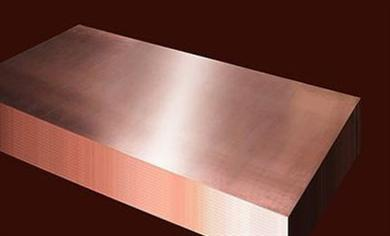
I remember the first time I spec’d a busbar for a major switchgear retrofit. The customer had a clear opinion: they wanted a copper bar 0.5 inch thick 12 inch length for switchgear. It sounded simple. Standard stuff. But when the bars arrived, two of them had a bow of nearly 1/8 inch over that short 12-inch span. That tiny bend made it impossible to align the connection holes with the main breaker lugs. We had to send them back. Lesson learned: not all copper bars are created equal, even when the dimensions match. Today, I will help you avoid that exact mistake by comparing your top options, covering the must-know standards, and explaining exactly what to look for in a 0.5 x 12 inch busbar.
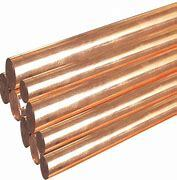
1. The Core Decision: C11000 vs C10100 for Your Switchgear Bar
When you order a copper bar 0.5 inch thick 12 inch length for switchgear, the first fork in the road is the alloy. The two heavyweights are C11000 (Electrolytic Tough Pitch, or ETP) and C10100 (Oxygen-Free, or OFHC). Which one belongs in your panel?
1.1 C11000 Copper: The Workhorse
C11000 is the default for 90% of switchgear applications. Why? Because it delivers 100% IACS (International Annealed Copper Standard) conductivity at a reasonable price. The chemistry includes a small amount of oxygen (around 0.04%) which actually helps refine the grain structure during casting. This makes C11000 bars stiff enough to maintain flatness under normal bolting torque. For a 0.5 inch thick bar at 12 inches long, C11000 is almost always sufficient for main distribution and grounding connections. The downside? If you ever need to weld or braze the bar in an oxygen-rich environment, the oxygen content can cause embrittlement. For most bolted switchgear assemblies, however, this is irrelevant.
1.2 C10100 Copper: The Premium Choice
C10100 is oxygen-free (less than 0.0005% oxygen). Why pay a 15-20% premium? Three reasons: superior ductility for tight bends, zero risk of hydrogen embrittlement if welding is required, and slightly higher conductivity (101% IACS vs 100%). If your switchgear design calls for a bar that is bent 90 degrees on its edge right at the 12-inch mark, C10100 will crack less often. It is also the go-to alloy for high-vibration environments (like marine switchgear) where micro-crack propagation under fatigue must be minimized. For a straight, drilled, and bolted 12-inch bar, C10100 is overkill. Choose it only when bending or welding is involved.
2. How to Compare Options: A Side-by-Side Feature Breakdown
Here is an honest comparison table that covers every aspect of the copper bar 0.5 inch thick 12 inch length for switchgear buying decision. Use it to match the bar to your specific job.
| Feature / Criteria | C11000 (ETP) Copper | C10100 (OFHC) Copper |
|---|---|---|
| Conductivity (% IACS) | 100% (minimum) | 101% (minimum) |
| Oxygen Content | ~0.04% | Less than 0.0005% |
| Ampacity (approx. at 75°C for 0.5 x 2 inch cross-section) | ~600 amps (DC or 60Hz AC, single bar) | ~608 amps (marginal improvement) |
| Bendability (edgewise 90°) | Good (may show minor cracking at very tight radius) | Excellent (can bend tighter without fractures) |
| Weldability / Brazing | Requires deoxidizing filler to avoid embrittlement | No special precautions needed |
| Cost per pound (approximate) | $4.50 – $6.50 / lb | $5.50 – $8.00 / lb |
| Typical surface finish options | Bare, tinned, or silver-plated | Bare, tinned, or silver-plated |
| Preferred edge type for switchgear | Rounded (corner radius ~1/32 inch) | Rounded (corner radius ~1/32 inch) |
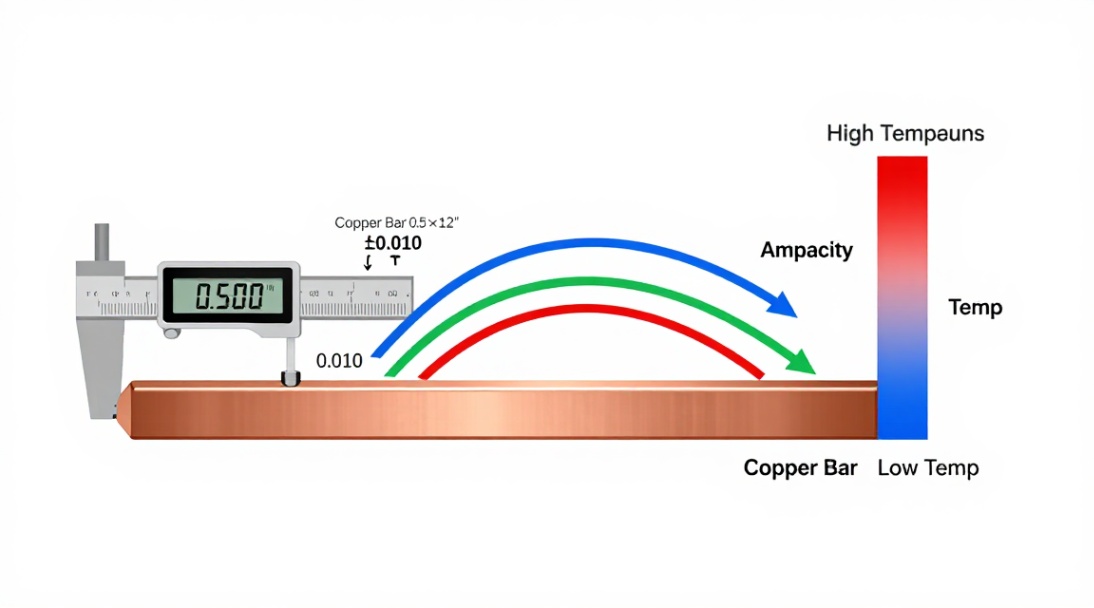
| Straightness tolerance (per 12 inch length) | 0.010 inch maximum bow (ASTM B187) | 0.008 inch maximum bow (tight spec) |
3. Standards and Tolerances: Why 0.010 Inch Matters
Your copper bar 0.5 inch thick 12 inch length for switchgear must meet ASTM B187 or B187M. These standards govern the chemical composition, tensile strength, and dimensional tolerances. For a 0.5-inch thick bar, the thickness tolerance is ±0.005 inch. The width tolerance depends on the width (you did not specify a width, but common widths for switchgear are 1 inch, 2 inches, or 4 inches). For a 2-inch wide bar, expect a width tolerance of ±0.008 inch. Here is the critical spec: straightness. ASTM B187 allows a bow of 1/8 inch (0.125 inch) over any 3-foot length. That is fine for long runs, but for a 12-inch bar, you should demand better. Insist on a maximum bow of 0.010 inch over the 12-inch length. That is what separated the good bars from the bad ones in my earlier story. Flatness is similar: the bar should not be twisted more than 1° across its width. A bar that is not straight or flat will cause misaligned joints and unequal pressure on the connecting lugs. That leads to hot spots. You do not want that.
4. Ampacity and Thermal Performance: How Much Current Can It Handle?
5. Surface Finish and Edge Type: Bare, Tinned, or Plated?
You have three surface choices for your copper bar 0.5 inch thick 12 inch length for switchgear: bare, tinned, or silver-plated. Here is the logical decision tree.
- Bare copper is cheapest and works in indoor, climate-controlled switchgear. Expect some oxidation (darkening) over time. This oxide layer is actually a mild insulator, so you must clean the contact surfaces with a wire brush or abrasive pad before assembly. Apply a thin film of anti-oxidant compound (like NO-OX-ID) to prevent re-oxidation.
- Tinned copper is the best choice for humid or coastal environments. The tin coating (applied by hot-dipping or electroplating) resists corrosion and keeps the surface conductive. It costs about 10% more. For outdoor or marine switchgear, choose tinned. Period.
- Silver-plated copper is used when the bar carries high-frequency currents (RF or high-speed switching power supplies) because silver has the lowest surface resistance. It is expensive and not necessary for 60Hz switchgear. Skip it unless your spec calls for it.
Edge type also matters. A sharp square edge is dangerous to handle and can cut wire insulation. Rounded edges (corner radius of 1/32 inch to 1/16 inch) are safer and reduce corona discharge at higher voltages (above 600V). Specify rounded edges on your purchase order.
6. Machining Your 12-Inch Bar: Drilling, Cutting, and Bending
You will likely need to drill holes in your copper bar 0.5 inch thick 12 inch length for switchgear. Here is the practical method. Use high-speed steel (HSS) or carbide-tipped drill bits. Lubricate with a sulfur-based cutting oil. Drill at a moderate speed (around 500-700 RPM for a 3/8-inch bit) with steady, light pressure. Peck frequently to clear chips. If you need to cut the bar to a shorter length, a band saw with a bi-metal blade (10-14 teeth per inch) works well. Finish the cut end with a file to remove burrs. Bending a 0.5-inch thick bar by 12 inches long requires a press brake or a bending jig. For a 90° bend, the minimum bend radius is 1.5 times the thickness for C11000 (0.75 inch radius) and 1.0 times the thickness for C10100 (0.5 inch radius). A tighter radius will cause cracking on the outer surface. Always bend across the grain if possible (i.e., the length axis of the bar is the grain direction). Bending with the grain increases crack risk.
7. Sourcing and Cost: What to Expect
Where do you buy a copper bar 0.5 inch thick 12 inch length for switchgear? You have two paths: a metal service center (like OnlineMetals, McMaster-Carr, or TW Metals) or a specialty electrical busbar manufacturer. A service center will sell you a 12-inch cut piece, often for a premium because of the short cut length. Expect to pay $8 to $15 per bar for a 2-inch wide piece, depending on alloy and finish. A busbar manufacturer can produce the bar with holes already punched, edges rounded, and surface finished to your exact spec. This saves labor but requires a minimum order quantity (often 50-100 pieces). For a one-off repair or small project, buy from a service center. For production runs, go directly to a mill or a fabricator. Ask for a certificate of compliance (COC) confirming ASTM B187 and lot traceability. Always verify the thickness with a micrometer at three points along the bar. I have seen bars that were 0.498 inch on one end and 0.502 inch on the other. Both are within spec, but the variance can cause uneven clamping pressure.
8. Final Recommendation and Your Next Step
Here is my hard recommendation for you. For standard indoor switchgear, choose a bare C11000 copper bar 0.5 inch thick 12 inch length, 2 inches wide, with rounded edges, meeting ASTM B187, with a straightness tolerance of 0.010 inch maximum. If your environment is humid, coastal, or outdoors, upgrade to tinned C11000. If your design requires a tight-bend radius or welding, invest in C10100 (oxygen-free) tinned copper. Do not overbuy. Do not under-spec. And never accept a bar that is not straight.
Now, take action. Call your supplier today. Give them this exact spec: “I need a copper bar 0.5 inch thick 12 inch length for switchgear, C11000, 2-inch width, rounded edges, bare finish, straightness 0.010 inch max, per ASTM B187. Please provide a COC and quote for 10 pieces.” Get the quote. Compare it to the table above. Then order with confidence. Your switchgear will run cooler, last longer, and you will sleep better knowing you picked the right bar. I guarantee it.
About CopperGroup
CopperGroup is a trusted global chemical material supplier & manufacturer with over 12 years experience in providing super high-quality copper and relative materials. The company export to many countries, such as USA, Canada,Europe,UAE,South Africa, etc. As a leading nanotechnology development manufacturer, CopperGroup dominates the market. Our professional work team provides perfect solutions to help improve the efficiency of various industries, create value, and easily cope with various challenges. If you are looking for copper products, please feel free to contact us!