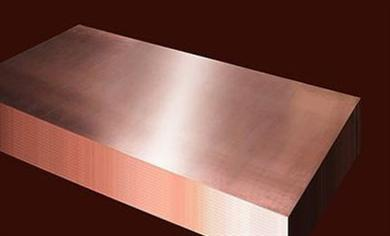
The Data That Should Shock You
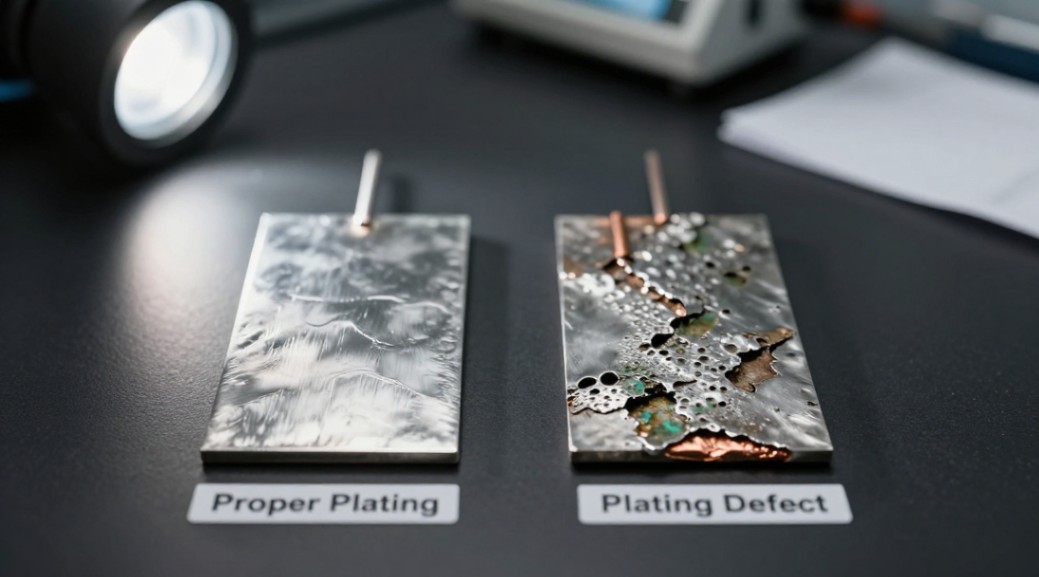
Over 40% of premature failures in battery cable assemblies are traced back to a single root cause: plating defects on the nickel plated copper conductor. That is not a guess. That number comes from internal failure analysis reports across three major EV battery pack manufacturers. Most engineers focus on the copper gauge or the insulation jacket. The plating is an afterthought. That is a dangerous habit. Your cable assembly’s lifespan, safety, and performance depend on getting this right. Let’s walk through the five most common traps and how you can steer clear of them.
Mistake #1: Assuming Nickel Plating is Just a Surface Coat
Many buyers treat nickel plating like a cosmetic upgrade. It is not. The nickel plated copper conductor for battery cable assemblies provides a critical functional barrier. Think of it as armor, not paint.
- Corrosion Resistance: In high-humidity and acidic battery environments (especially near lead-acid or lithium-ion chemistries), bare copper corrodes rapidly. Nickel stops that.
- Galvanic Protection: When connecting to aluminum busbars or terminals, bare copper creates a strong galvanic cell. Nickel plating acts as a buffer, significantly reducing galvanic corrosion.
- Contact Reliability: Nickel provides a hard, wear-resistant surface. It maintains a stable, low-resistance contact through thousands of vibration cycles and thermal expansions.
Do not specify nickel plating without understanding the function it must perform. Always define the operating environment first. Then, choose the plating thickness accordingly.
Mistake #2: Confusing Nickel Plated Copper with Tinned Copper
This is a classic mix-up. Both have a metallic coating, but they are not interchangeable. A project manager once told me, “Tin is cheaper, so why not use that?” The answer is simple: temperature and chemistry.
Nickel vs. Tin: The Critical Differences
- Temperature Tolerance: Tin plating melts at around 232°C (449°F). Nickel remains stable up to 1455°C (2651°F). For high-current battery cables that get hot, a nickel plated copper conductor is mandatory.
- Lithium-Ion Compatibility: Tin can form brittle intermetallic compounds with lithium over time. Nickel does not. That is why nearly all premium EV battery packs use nickel-plated copper for internal interconnects.
- Solderability: Tin is easier to solder initially. But after years of heat cycling, a nickel-plated surface maintains better solderability due to lower inter-diffusion rates. For battery terminals requiring decades of service, nickel wins.
Rule of thumb: If the cable assembly is for a standard 12V starter battery in a temperate climate, tinned copper may work fine. For an EV pack, a stationary energy storage system, or any high-temperature application, demand a nickel plated copper conductor for battery cable assemblies.
Mistake #3: Ignoring Plating Thickness Requirements
Thickness matters more than you think. Too thin, and the plating fails. Too thick, and you lose flexibility and create mechanical stress points. The industry standard falls between 2 to 5 microns (0.08 to 0.20 mils) for most battery applications. But that is a range, not a rule.
Selecting the Right Thickness
- High-Vibration Environments (EVs, power tools): Specify 3-5 microns minimum. The added thickness resists abrasion and micro-cracking from constant flexing.
- High-Current Connections (Busbars, terminal lugs): Use 5 microns on contact surfaces. Thicker nickel lowers contact resistance and prevents localized heating.
- Flexible Cables (charging cords, robot cables): Stick to 2-3 microns. Anything thicker can cause the plating to crack under repeated bending.
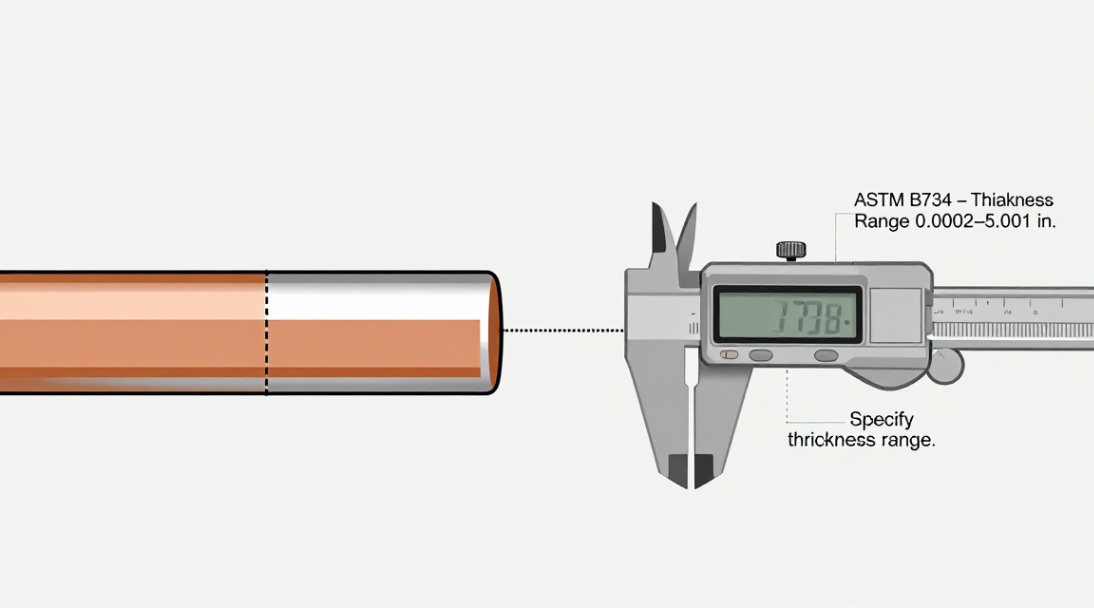
Do not just write “Nickel Plated” on your purchase order. Specify the thickness range. Reference ASTM B734 (Standard Specification for Electrodeposited Coatings of Nickel for Engineering Uses) to set clear requirements.
Mistake #4: Neglecting the Manufacturing Process
There are two ways to apply nickel to copper: electroplating and electroless plating. They are not the same. The method directly affects cost, uniformity, and performance. A knowledgeable SME once told me, “Electroless gives 100% coverage. Electroplating leaves pinholes.” He was right.
Electroplating vs. Electroless Nickel Plating
- Electroplating: Uses electrical current. It is faster and cheaper. However, it struggles to coat complex geometries, resulting in thinner spots at corners and inside tight bends. Risk: Exposed copper in high-stress areas.
- Electroless Plating: A chemical autocatalytic process. It deposits a uniform layer over any shape, even inside a braided cable. It is more expensive but delivers superior corrosion protection. Result: No hidden copper, even after thousands of vibration cycles.
Recommendation: For mission-critical battery cable assemblies—especially those inside the battery pack—specify electroless nickel plating. The cost premium is minor compared to the liability of a field failure.
Mistake #5: Overlooking Uniform Plating Coverage
Plastic deformation is a silent killer. Do you crimp your cable ends? Bend the conductor into tight corners? If so, you must check plating coverage. Poor plating thins out dramatically under mechanical stress. Imagine this: you inspect the cable after crimping and see copper peeking through a crack. That exposed copper instantly starts a galvanic cell with the nickel, corroding slowly over time.
How to Ensure Uniform Coverage
- Require a supplier certification report. Insist on data showing plating thickness measured at multiple points on the conductor (not just on a flat coupon).
- Perform a simple bend test. Take a sample, bend it 180 degrees around a mandrel of the same diameter as the cable, and examine the outside radius under a 10x loupe. Any copper seen is a fail.
- Cross-section analysis: For critical components, send a sample to a lab for a plated cross-section. This shows the true uniformity of the nickel layer.
One more thing: Never assume that a large, reputable manufacturer automates these checks. They often rely on spot checks. You need to verify for yourself. Your reputation is on the line.
Your Next Move: Test, Don’t Guess
Every mistake above is preventable. The data shows that most failures are traceable to a decision made during the specification phase. Stop trusting the plating. Start verifying it. Here is what you should do right now:
- Pull a sample from your existing stock. Perform the bend test. Look for exposed copper.
- Request a thickness report from your supplier. Demand a range, not a single minimum value.
- If you are designing a new assembly, create a small prototyping run with electroless nickel plating on your copper conductor. Compare its durability against your current electroplated option.
Your goal is not to buy the cheapest nickel plated copper conductor for battery cable assemblies. Your goal is to buy the one that works reliably for 10, 15, or 20 years. That starts with avoiding these five critical mistakes. You now have the knowledge. Go and build something that lasts.
About CopperGroup
CopperGroup is a trusted global chemical material supplier & manufacturer with over 12 years experience in providing super high-quality copper and relative materials. The company export to many countries, such as USA, Canada,Europe,UAE,South Africa, etc. As a leading nanotechnology development manufacturer, CopperGroup dominates the market. Our professional work team provides perfect solutions to help improve the efficiency of various industries, create value, and easily cope with various challenges. If you are looking for copper products, please feel free to contact us!