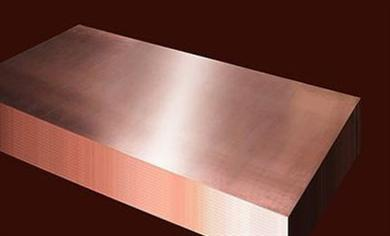
The Straight Answer: Why 10x5mm Is the Goldilocks Busbar (But Only for the Right Job)
Let’s kill the suspense. For low-to-medium current applications in confined spaces, the copper bar 10mm x 5mm for electrical busbars is your best bet. It’s compact, it’s strong, and it handles the thermal load. But use it for a 600A main breaker, and you’ll be designing a fire hazard. This is your no-BS comparison.
1. The Baseline: The 10x5mm Workhorse
This bar gives you a 50mm² cross-section. Pure physics. No magic. Here is what that means in real terms.
- Ampacity: At 30°C ambient, a bare 10x5mm bar carries roughly 230-250A. Tinned? Drop that by 10%. Enclosed in a panel with no airflow? You are at 180A max. Do not exceed these numbers without active cooling.
- Conductivity: You need minimum 100% IACS. That means C11000 (ETP) or C10100 (OFC). If a supplier sells you ‘electrical grade’ without a cert, walk away.
- Mechanicals: The tensile strength sits around 200-250 MPa (half-hard). You can bend it cleanly on a 2T radius. You can drill it with HSS bits. You can cut it with a bandsaw. It behaves.
- Surface: Bare is fine for dry, clean indoor environments. For anything with humidity or pollution, demand tinned. For critical switchgear, silver-plating drops contact resistance by 30%. Cheap insurance.
1.1. The Ugly Truth: Surface Finishes and Corrosion
Bare copper oxidizes. That oxide layer is a semiconductor. It creates hot spots. A tinned or silver-plated bar will outlast a bare bar by 5x in a coastal plant. Your choice. Pay now or pay later.
2. The Opponent: 8x8mm Copper Bar (The Square Alternative)
64mm² cross-section vs. 50mm². The 8x8mm has 28% more copper. Why would you ever pick the smaller 10x5mm?
- Space Factor: 10x5mm is a flat bar. It fits in a 10mm deep slot. The 8x8mm is square. It needs 8mm depth but also 8mm width. In a tight panel, the flat profile of 10x5mm wins.
- Skin Effect: For DC, it doesn’t matter. For 50/60Hz AC, the 10x5mm has better surface-to-volume ratio. It sheds heat faster. The 8x8mm runs hotter inside.
- Bending: A 10x5mm bar bends easily on the flat side. The 8x8mm is a brute. It resists bending. You’ll need heavier tools.
- Verdict: Use 10x5mm when routing is complex and panel depth is critical. Use 8x8mm when you need brute ampacity in a short, straight run and have space to spare.
3. The Other Contender: 12x5mm Copper Bar (The Overachiever)
60mm² cross-section. 20% more copper. Same 5mm thickness. This is the direct upgrade path.
- Ampacity Gain: You get roughly 270-290A (bare, open air). That’s about 15-20% more current for a 20% increase in copper mass. Efficient.
- Same Thickness: Because the thickness is identical (5mm), your bending dies, your drills, your connectors all work. Zero retooling.
- When to Choose: If your load calculation shows 240A continuous, the 10x5mm is at its limit. The 12x5mm gives you a 50A safety margin. Buy the 12x5mm.
- When to Reject: If panel space is allocated for 10mm width busbars, you cannot jam in a 12mm bar. It won’t fit. Measure twice.
4. Critical Engineering Decision: Voltage Drop and Thermal Rise
You cannot ignore this. A 50mm² bar has a resistance of about 0.35 mΩ/m at 20°C. Let’s do the math.
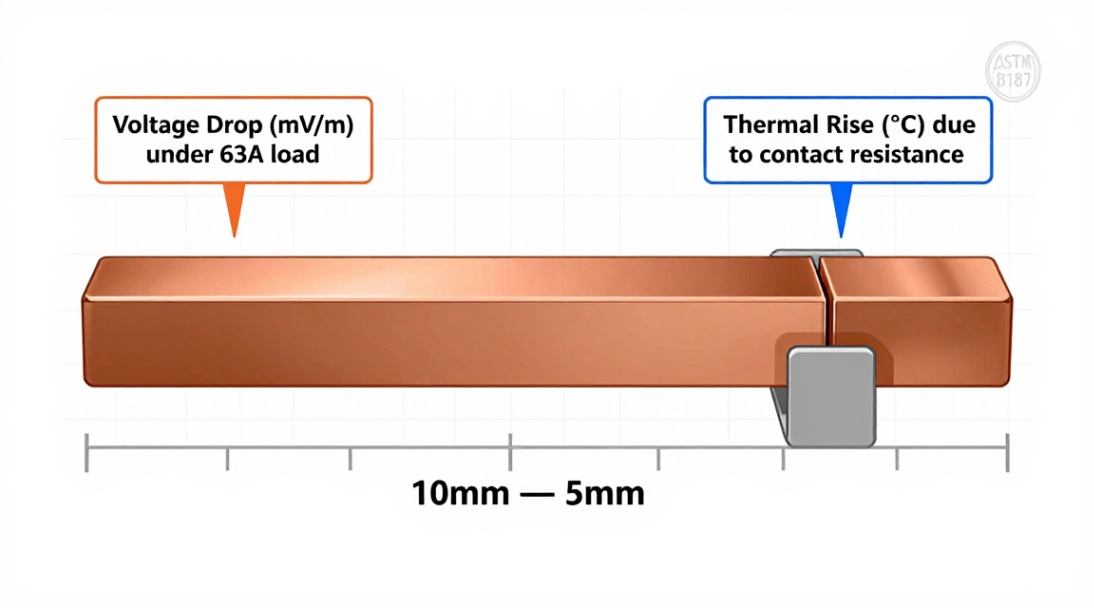
- Voltage Drop: For a 2-meter run carrying 200A: Vdrop = 200 * 0.00035 * 2 = 0.14V. That’s 0.12% on a 120V system. Acceptable. For a 10-meter run? 0.7V drop. Not acceptable for sensitive electronics.
- Thermal Rise: At 200A in free air, the bar will rise about 45°C above ambient. In a sealed enclosure, expect 70°C rise. That’s hot. Touch it and you get burned. Use thermal imaging on commissioning.
- Rule of Thumb: Keep the length under 3 meters for 10x5mm at rated current, or double the bar (paralleling) to halve the resistance.
5. The Naked Truth About Standards: ASTM B187, EN 13601, and IEC 61439-1
- ASTM B187: The US standard. C11000. 100% IACS min. This is the baseline. If your supplier says ‘meets ASTM B187’, ask for the cert. If they can’t produce it, they are lying.
- EN 13601: The European standard. Similar conductivity. Different testing protocols. For EU projects, this is mandatory.
- IEC 61439-1: This is the assembly standard. It tells you how to mount the bar, what clearances to keep, and how to test the temperature rise. Your busbar can be perfect; but if your assembly fails IEC 61439-1, it’s scrap.
Do not mix standards. A C11000 bar meeting ASTM B187 is fine for a US panel. Using it in an EU-certified switchgear without EN 13601 compliance is a legal liability.
6. The Hidden Danger: Edge Rounding and Burrs
Sharp edges on a busbar kill insulation. They create high-voltage stress points. They cause partial discharge. In a 690V system, a burr can ionize the air. You get ozone. You get tracking. You get a short circuit.
- Requirement: Specify edge radius of 0.5mm minimum. No burrs. Deburring is not optional.
- Inspection: Run a cotton ball along the edge. If it snags, reject the bar.
- Cost: Deburring adds 2-3% to the bar cost. It prevents a 100% panel failure. Worth it.
7. Sourcing: The Devil in the Tolerances
A ’10mm x 5mm’ bar from a cheap supplier might actually be 9.8mm x 4.9mm. That’s a 4% reduction in cross-section. That’s a 4% increase in resistance and temperature.
- Specify Tolerances: Demand ±0.05mm on thickness. Demand ±0.10mm on width. Anything looser is scrap.
- Straightness: The bar must be straight within 1mm per meter. Bent bars cause alignment nightmares in multi-phase busway systems.
- Cut-to-Length: Order it cut. Field cutting with an angle grinder introduces burrs. If you must cut in the field, use a cold saw with a carbide blade. No grinders.
8. Final Comparison Table: 10x5mm vs. 8x8mm vs. 12x5mm
Stop reading theory. Here is the hard data.
| Property | 10mm x 5mm | 8mm x 8mm | 12mm x 5mm |
|---|---|---|---|
| Cross-Section (mm²) | 50 | 64 | 60 |
| Ampacity (Bare, 30°C, Open Air) | 230-250A | 280-310A | 270-290A |
| Ampacity (Tinned, 30°C, Open Air) | 200-225A | 250-280A | 240-260A |
| Resistance (mΩ/m @20°C) | 0.35 | 0.27 | 0.29 |
| Bending Difficulty | Easy (flat bend) | Hard (square) | Easy (flat bend) |
| Best Use Case | Tight panels, complex routing | Short, high-current runs | Direct upgrade from 10x5mm |
Conclusion: Trust the Math, Not the Sales Pitch
Here is your cheat sheet. Use copper bar 10mm x 5mm for electrical busbars when your current is under 200A continuous, your panel depth is tight, and you have multiple bends. Switch to 12x5mm if you need a safety margin. Use 8x8mm only for short, straight, high-current links where you have space. Demand certified material. Deburr your edges. Calculate your voltage drop. Now go build something that won’t melt.
About CopperGroup
CopperGroup is a trusted global chemical material supplier & manufacturer with over 12 years experience in providing super high-quality copper and relative materials. The company export to many countries, such as USA, Canada,Europe,UAE,South Africa, etc. As a leading nanotechnology development manufacturer, CopperGroup dominates the market. Our professional work team provides perfect solutions to help improve the efficiency of various industries, create value, and easily cope with various challenges. If you are looking for copper products, please feel free to contact us!