Stop Wasting Money on “Close Enough” Busbars
Here is the short answer: custom copper busbar bar sizes are not a luxury. They are a necessity for any design that cares about ampacity, mechanical fit, or long-term reliability. We have seen too many engineers try to force a standard 1/4 x 2 inch bar into a 63mm duct. It doesn’t work. It creates hot spots, loose connections, and field rework that eats your margin. We are going to show you exactly what to specify, why it matters, and how to avoid the classic rookie mistakes.

Many users on Reddit and engineering forums have shared the same pain: a standard busbar arrives, the hole pattern is 3 mm off, and suddenly the whole switchgear assembly is delayed. That is the reality of working with suppliers who only stock standard sizes. You need a partner who treats your print like a blueprint, not a suggestion.
1. The Grade Game: ETP vs. OFHC – Why Purity Isn’t a Luxury
Picking the right copper grade is the single most important decision. Here is the breakdown:
- C11000 (ETP – Electrolytic Tough Pitch): This is your workhorse. 99.9% copper. Conductivity of 101% IACS. Perfect for 95% of busbar applications. The .04% oxygen content is fine for standard indoor gear. Do not over-spec. This will save you money.
- C10100 (OFHC – Oxygen-Free High Conductivity): 99.99% copper. Conductivity hits 101% IACS or higher. This is for high-vibration environments, vacuum interrupters, or any application above 600A where hydrogen embrittlement is a real risk. We only spec OFHC when the weld joint is critical, or the environment is sealed.
Our opinion: If you are in a standard MCC or panel, use C11000. Don’t let a supplier upsell you on OFHC unless you can prove you need it. When you ask for a copper busbar bar supplier custom sizes, make sure they ask which grade you want. If they don’t, run.
2. Dimensional Precision: The 0.5mm Rule That Saves Your Assembly
Standard busbar stock sizes are a trap. They are rolled to nominal dimensions, with tolerances that will ruin your day. Here is what you must demand:
- Thickness tolerance: ±0.05 mm (0.002 inches) for any bar under 10 mm thick. Full stop.
- Width tolerance: ±0.3 mm (0.012 inches). If you need a tight fit in a slot, spec ±0.1 mm.
- Length tolerance: +0 / -1.0 mm. We always prefer a negative-only tolerance so the bar fits without filing.
- Twist and Flatness: Maximum 1 mm over 1 meter. Any more, and your busbars will look like a potato chip.
Real-world example: We had a client spec a 6 x 50 mm busbar. The supplier sent standard stock that measured 5.85 x 49.2 mm. The ampacity dropped by 8%. The customer caught it on a digital micrometer. The rework cost the supplier more than the original order. Do not let that be you. Every time you search for copper busbar bar supplier custom sizes, put tolerance requirements in your RFQ.
3. Ampacity Isn’t Magic: Cross-Section Math You Can Do Right Now
Ampacity is ruled by surface area and cross-section. Here is the rule of thumb for a 30°C rise in still air:
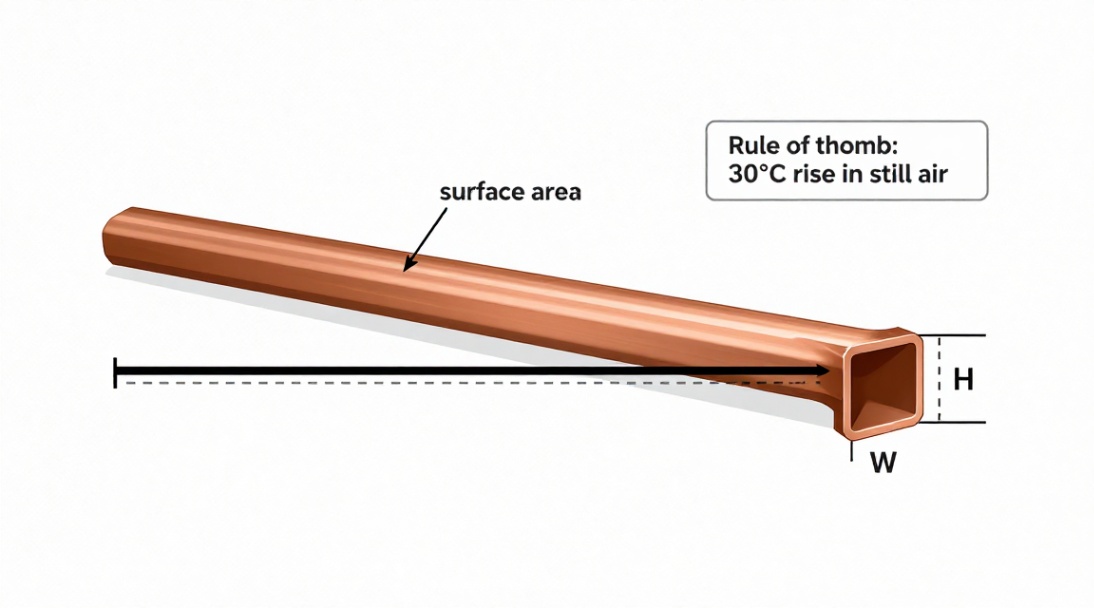
- 1 mm² of cross-section: Roughly 1.5 A for a naked, horizontal bar.
- Example: A 6 x 30 mm bar (180 mm²). Theoretical ampacity = ~270 A.
- But if it’s enclosed? Derate to 70%. That same bar is now ~190 A.
Thermal performance nuance: A thicker bar runs cooler per amp because the core heat struggles to escape. Two 3 mm bars stacked have more surface area than one 6 mm bar. Always consider venting and enclosure material. Custom sizing allows you to optimize this perfectly, which is why a top copper busbar bar supplier custom sizes specialist will always ask about your enclosure volume.
4. Hardness and Temper: Flexible vs. Strong – Pick a Struggle
You cannot have a busbar that bends easily and also holds its shape under a short-circuit. Here is the cheat sheet:
- Soft (Annealed): 40-50 Rockwell F. Bends beautifully. Use it for complex 3D busbars or compensation straps. It will deform under high stress.
- Half-Hard (H02): 60-70 Rockwell F. The sweet spot for 90% of applications. Easy to drill, holds a shape, and handles moderate fault currents.
- Full-Hard (H04): 80+ Rockwell F. Great for straight, rigid runs in high-current switchgear. If you need to bend it, you will crack it.
Pro tip: If you need to bend a half-hard bar across the thickness (edgewise bend), you must anneal the bend zone or order it pre-formed. Many custom suppliers will do this for a few dollars per bend.
5. Surface Finish and Plating: Tin vs. Silver vs. Bare – The Corrosion Reality
Bare copper is fine indoors in a climate-controlled environment. Outside? It tarnishes fast, and contact resistance climbs.
- Bare copper (ETP): Only for clean, indoor assemblies. Conductivity is max. Cost is low. Will blacken in 6 months in humidity.
- Tin-plated (ASTM B545): 5-10 micron. Great for corrosion resistance in coastal or high-humidity areas. Also prevents galvanic corrosion when mated to aluminum. Slightly increases contact resistance (negligible).
- Silver-plated (ASTM B700): 10-20 micron. Lowest contact resistance. Essential for high-cycle disconnect switches or vacuum breakers. Expensive. Do not use in a sulfide-heavy environment (paper mills, sewage). It will turn black.
Our recommendation: Tin-plate is the default for 90% of custom busbars. It is cost-effective and gives you a 10-year corrosion guarantee in most environments. When requesting copper busbar bar supplier custom sizes, always ask if they can do re-plating after machining. Cut edges are bare copper hotspots.
6. Fabrication Capabilities: CNC or Bust – What to Demand from Your Supplier
A supplier who just cuts bars is not a fabricator. You need a shop with real machinery.
- CNC punching and drilling: Hole position tolerance of ±0.1 mm. This is non-negotiable if you are mounting breakers. Demand a CMM report.
- Chamfering and deburring: All edges must be broken to a 0.5 mm radius. Sharp edges cause corona discharge in high-voltage, and cuts on hands during installation.
- Tapping and threading: Must be done after plating. Verify the depth with a plug gauge.
- Keyways and special profiles: Any supplier worth their salt can mill a T-slot or a dovetail. Ask for a 3D model of the finished part before they cut.
7. MOQ and Lead Times: The Hidden Trap of Custom Work
Here is the brutal truth: custom busbars have a minimum order quantity (MOQ). For a simple cut-to-length bar, MOQ is usually 50 kg. For a complex CNC-machined part, MOQ can be 200 kg.
- Cut-to-length, no holes: Lead time 5-7 days. MOQ: 50 kg.
- Cut-to-length with drilled holes: Lead time 10-14 days. MOQ: 100 kg.
- Full CNC profiling, plating, inspection report: Lead time 3-4 weeks. MOQ: 200 kg.
How to beat this: Combine multiple projects into one PO. Many suppliers will give a volume discount (often 5-10%) for orders over 500 kg. Plan ahead. The cheapest busbar is the one you have already installed.
8. Quality Certifications: The Paper That Proves Your Bar Works
You need a mill test certificate (MTC) per ASTM B187. Do not accept anything less. The MTC must show:
- Chemical composition (copper + impurities).
- Conductivity test result at 20°C.
- Hardness test result (if specified).
- Dimensional inspection report with actual measurements.
We also recommend asking for a micrograph of the grain structure for oxygen-free grades. This proves it was annealed properly. A good supplier will email this with the shipment. A bad supplier will charge extra for it.
9. Pricing Factors: Why One Supplier is $2/kg More Than Another
It is not just copper commodity price, which fluctuates daily. Custom fabrication adds real cost.
- Commodity price: Base copper + supplier margin (typically 5-15%).
- Scrap value of removed material: If the part has a lot of machining waste, the scrap byproduct is deducted from the price. Ask about this. It can reduce cost by 3-5%.
- Fabrication complexity: Each CNC operation adds ~$1-3 per hit. A bar with 20 holes and two chamfers is noticeably more expensive than a blank.
- Volume discount: Typically 5% for 500-999 kg, up to 10% for 1000+ kg. Negotiate this upfront.
You do not have to accept the first quote. A good copper busbar bar supplier custom sizes specialist will break down the cost for you.
10. Packaging: Don’t Let a Good Bar Get Bent in Transit
A 2-meter long busbar is floppy. It will bow and bend if thrown on a truck.
- Individual sleeves: Each bar must be wrapped in VCI paper (vapor corrosion inhibitor).
- Rigid plywood crate: For bars over 1.5 meters, require a crate with a hard spine. No soft bundles.
- Edge protectors: Cardboard or plastic corners on every bar end to prevent plating damage from friction.
- Lashing points: The crate must be securable to the truck bed.
Inspect the packaging at the dock. If the crate is damaged, do not sign for it. Photograph everything. This is your leverage for a replacement.
11. How to Request a Quote: The 10-Item Checklist
Stop sending an email that says “Send me a price for a 6mm bar.” Use this checklist instead:
- Copper grade: C11000 or C10100.
- Dimensions: Exact width (mm), thickness (mm), length (mm) with tolerances.
- Quantity: Number of pieces and total weight.
- Hole pattern: A PDF or DXF drawing with hole positions, diameters, and chamfer requirements.
- Plating: Bare, tin (5-10µ), silver (10-20µ).
- Hardness: Soft, half-hard, full-hard.
- Testing: ASTM B187 MTC? Conductivity test? Dimensional report?
- Packaging: VCI paper? Crate? Individual wrapping?
- Lead time: Required delivery date.
- Delivery terms: Ex-works? FOB? DDP?
Include a drawing or a sketch. A 30-second drawing saves a 30-minute argument. This is the only way to get an accurate, competitive quote for copper busbar bar supplier custom sizes.
Quick Reference Table: Standard vs. Custom Busbar Specs
| Specification | Standard Stock (Typical) | Custom (Recommended) |
|---|---|---|
| Thickness tolerance | ±0.1 mm | ±0.05 mm |
| Width tolerance | ±0.5 mm | ±0.3 mm |
| Length tolerance | ±2.0 mm | +0 / -1.0 mm |
| Hole position tolerance | ±0.5 mm | ±0.1 mm |
| Twist (per meter) | 2.5 mm | 1.0 mm |
| Flatness (per meter) | 2.0 mm | 1.0 mm |
| Surface finish | As-rolled, sharp edges | Deburred, chamfered 0.5mm |
| Plating (if specified) | Edge stripe may be bare | Full coverage + post-machining touch-up |
| Certification | None or basic MTC | Full ASTM B187 + Dimensional report |
This table is your cheat sheet. Use it when reviewing supplier quotes.
Your Next Move: Go Custom or Go Home
Standard sizes are a crutch. They are for shelves, not switchgear. If you are designing a critical power path, the cost of rework and downtime dwarfs the 10% premium for custom machining. We have seen it play out a hundred times: the custom quote arrives, the project manager hesitates, and then the standard bar fails a dimension check on site. The schedule slips. The blame lands on you.
Do not take that risk. Send the 10-item checklist to a supplier who understands copper busbar bar supplier custom sizes. Ask for a tolerance analysis. Get the MTC. Sleep better knowing your busbar fits on the first try.
If you need a partner who treats custom as standard, we can help. Drop your drawing into a request. We will quote you within 48 hours, with full transparent cost breakdown and a lead time you can trust.
About CopperGroup
CopperGroup is a trusted global chemical material supplier & manufacturer with over 12 years experience in providing super high-quality copper and relative materials. The company export to many countries, such as USA, Canada,Europe,UAE,South Africa, etc. As a leading nanotechnology development manufacturer, CopperGroup dominates the market. Our professional work team provides perfect solutions to help improve the efficiency of various industries, create value, and easily cope with various challenges. If you are looking for copper products, please feel free to contact us!