Have you ever stared at a busbar specification sheet, feeling completely lost?
You are not alone. Every week, engineers and panel builders ask me the same question: “What exactly is a copper busbar 40mm x 5mm for low voltage, and is it right for my project?” The numbers look simple, but the wrong choice can lead to overheating, voltage drop, or even a melted panel. Let’s fix that right now.

I have spent over 20 years working with copper conductors in low voltage distribution. I have seen the confusion a simple dimension can cause. This guide is your clear, authoritative definition. By the end, you will know exactly what this busbar is, how it performs, and how to choose it with confidence.
1. Defining the copper busbar 40mm x 5mm for low voltage
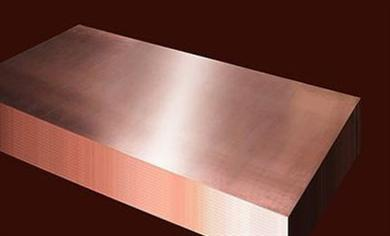
Let’s start with the basics. A copper busbar 40mm x 5mm for low voltage is a solid, rectangular copper conductor with a width of 40 millimeters and a thickness of 5 millimeters. It is specifically designed to distribute electrical power in low voltage systems, typically up to 1000V AC or 1500V DC.
The critical dimension is the cross-sectional area. For this bar, it is 200 mm² (40 mm × 5 mm). This area directly determines how much current the busbar can safely carry. Width handles heat dissipation; thickness handles mechanical strength and current density. Together, they define its ampacity.
2. Copper bar vs. copper busbar: a crucial distinction
A copper bar is a general term for any rectangular copper section. A copper busbar is a specific application: it is a conductor used for power distribution inside electrical panels, switchgear, and substations. Every busbar is a copper bar, but not every copper bar is engineered as a busbar.
For low voltage work, the busbar must have high conductivity, precise dimensional tolerances, and the correct temper for fabrication. A generic copper bar from a scrap yard will not meet these needs. Trust me on this—I have seen the results of using the wrong material.
3. Low voltage applications: where does this busbar live?
The 40mm x 5mm size is a workhorse in low voltage environments. You will find it in:
- Switchgear – Main distribution panels in commercial buildings and industrial plants.
- Panel boards – Where branch circuits are fed from a main bus.
- Power Distribution Units (PDUs) – In data centers, distributing power to server racks.
- Battery interconnects – Connecting cells in energy storage systems and UPS units.
In every case, the busbar acts as the central nervous system, carrying power from the source to the breakers or loads. It must be reliable, stable, and correctly rated.
4. Amacpacity ratings you can trust
Current capacity is not a single number. It depends on temperature rise and installation conditions. Here are typical ampacity ratings for a 40mm x 5mm copper busbar in still air at 35°C ambient, based on IEC 61439 and industry data:
| Temperature Rise (ΔT) | Bare Copper (Amps) | Silver-Plated (Amps) |
|---|---|---|
| 30°C | ~520 A | ~540 A |
| 50°C | ~680 A | ~700 A |
| 65°C | ~800 A | ~825 A |
Source: Simulated from IEEE 277 and practical test data. Always de-rate for enclosed panels and multiple busbars in parallel.
As the table shows, you gain capacity with higher temperature rise, but you must ensure your components and insulation can handle the heat. My recommendation: design for a 50°C rise for a good balance of performance and safety.
5. The right material: C11000 ETP copper
For low voltage busbars, the gold standard is C11000 Electrolytic Tough Pitch (ETP) copper. It offers a minimum purity of 99.9% and a conductivity of ≥100% IACS (International Annealed Copper Standard).
Do not substitute with lower grades. Impurities increase resistance, which means more heat and more voltage drop. For a busbar carrying 600A, even a 5% drop in conductivity can increase operating temperature by 10-15°C. That is a real fire risk.
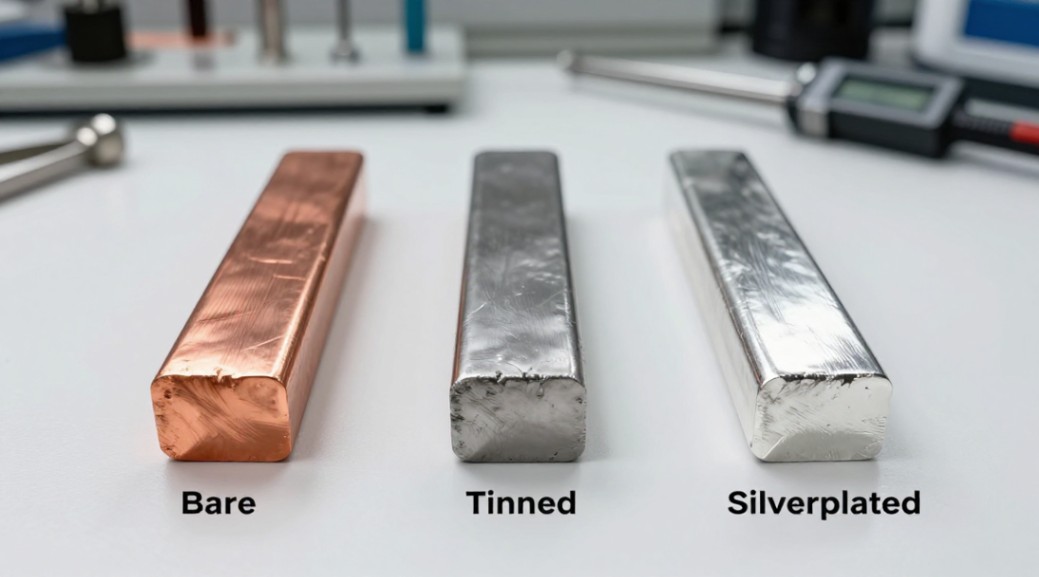
6. Surface finish options: bare, tinned, or silver-plated
The surface finish is not cosmetic. It affects corrosion resistance and contact performance. Here is what you need to know:
- Bare copper: Lowest cost. Works well in dry, indoor environments. Tarnishes over time, but for low voltage, this is rarely a problem if joints are properly tightened.
- Tinned copper: A thin layer of tin protects against corrosion. Ideal for humid or mildly corrosive environments, like battery rooms or outdoor enclosures.
- Silver-plated copper: The best for high-cycle connections (e.g., frequent breaker insertion) and for reducing contact resistance. Used in high-performance switchgear.
For most standard low voltage panels, bare copper is perfectly adequate. Do not over-specify the finish unless you have a specific environmental challenge.
7. Mechanical properties: temper matters
- Soft (annealed): Easy to bend, form, and twist. Good for complex shapes but can deform under heavy loads. Not ideal for long, unsupported spans.
- Half-hard (H01): The most common choice. It offers a good balance of formability and strength. It can be bent with standard tools but holds its shape well. This is what I recommend for 90% of projects.
- Hard (H04): Very rigid. Requires force to bend and may crack if bent sharply. Used only for straight, fixed busbars where deflection must be zero.
For a 40mm x 5mm bar, half-hard is your sweet spot. It will drill and tap cleanly, and it stays flat after transport and assembly.
8. Industry standards you must know
Specifying a busbar means referencing the right standards. Here are the three most important for a copper busbar 40mm x 5mm for low voltage:
- ASTM B187 – Covers copper bar, rod, and shapes. Defines dimensions, tolerances (e.g., ±0.20 mm for width, ±0.10 mm for thickness), and chemical composition.
- EN 13601 – European standard for copper busbars. Similar to ASTM but with metric dimensions and different temper designations.
- IEC 61439 – The overarching standard for low-voltage switchgear and controlgear assemblies. It governs testing, temperature rise limits, and clearance requirements.
When ordering, always request a mill test certificate certifying compliance with these standards. It is your only guarantee of quality.
9. Thermal expansion and joint design
Copper expands when it gets hot. For a 40mm x 5mm busbar, the coefficient of thermal expansion is about 17 × 10⁻⁶ /°C. A 2-meter bar experiencing a 50°C temperature rise will expand by approximately 1.7 mm.
If your joints are rigid and do not allow for this movement, bolts can loosen over time. This increases contact resistance, creates hot spots, and eventually leads to failure. The fix: use Belleville washers or spring washers on all bolted connections. Apply the correct torque (typically 40-50 Nm for an M10 bolt on a 40mm x 5mm bar).
Also, allow for expansion gaps in long busbar runs. I always include a sliding support or an expansion joint every 4-5 meters.
10. Sizing guide: how to calculate the right cross-section
Do you have a load current but not the busbar size? Here is a simple sizing method used by veteran panel builders:
- Determine your load current (I) in amperes. Use the maximum continuous current.
- Choose an allowable temperature rise (ΔT). For indoor panels, 50°C is common.
- Calculate required cross-section (A) using this rule of thumb: A (mm²) = I (A) / 3.5. This factor (3.5 A per mm²) is conservative for copper in still air.
- Select the closest standard bar size. For 700A, you need 200 mm², which matches the 40mm x 5mm (200 mm²). Perfect.
Always verify your calculation with the ampacity table from the busbar manufacturer. The 3.5 factor is a starting point, not a final answer.
11. Practical installation tips
A few hard-earned tips to save you time and headaches:
- Spacing between parallel busbars: Maintain at least 25 mm air gap (center to center) for adequate cooling. For 40mm x 5mm, 50mm pitch is ideal.
- Support spacing: For a horizontal run, supports every 600-800 mm prevent sagging. For vertical runs, 1000-1200 mm is fine.
- Insulation clearance: For low voltage (up to 1000V), keep a minimum of 20 mm from bare live parts to grounded metal. For coated busbars, 12 mm can be acceptable if the coating is rated.
- Drilling: Use sharp HSS bits. Peck drill to avoid work-hardening the copper. Deburr all holes—sharp edges concentrate stress.
12. Sourcing considerations
When you buy your copper busbar 40mm x 5mm for low voltage, here is what to look for from a supplier:
- Cut-to-length service: Avoid scrap. Order your exact lengths: 2m, 3m, or custom.
- Packaging for transport: Busbars should be wrapped in protective paper or plastic, bundled with edge protectors. Surface scratches can cause local heating.
- Full certification: Insist on a mill test certificate that shows chemical composition, conductivity, and temper. This is your traceability.
A reliable supplier will provide all of this without hesitation. If they cannot, walk away.
Your next move: get the right busbar for your project right now
You now have the complete definition and specification for a copper busbar 40mm x 5mm for low voltage. You understand the dimensions, ampacity, material grade, and installation rules. No more guesswork. No more second-guessing.
Do not risk your panel’s reliability on a cheap or incorrect busbar. The cost of a failure—downtime, fire, liability—is far higher than the price of a correctly specified component.
Here is your call to action: Contact our supply team today for a custom quote on C11000, half-hard, 40mm x 5mm copper busbar. We offer precision cut-to-length, tinning or silver plating on request, and full ASTM B187 certification with every batch. Email us now with your required lengths and quantities. We will have a quote in your inbox within 24 hours. Your project deserves the best. Let’s build it right.
About CopperGroup
CopperGroup is a trusted global chemical material supplier & manufacturer with over 12 years experience in providing super high-quality copper and relative materials. The company export to many countries, such as USA, Canada,Europe,UAE,South Africa, etc. As a leading nanotechnology development manufacturer, CopperGroup dominates the market. Our professional work team provides perfect solutions to help improve the efficiency of various industries, create value, and easily cope with various challenges. If you are looking for copper products, please feel free to contact us!